
Fire and security reporting compliance in Ireland 2026


Most property managers think fire safety reporting is a one-time box to tick. That’s wrong. Under Irish law, fire and security reporting is a continuous legal obligation requiring structured inspections, accurate documentation, and proactive compliance with evolving standards. This guide clarifies your legal duties, introduces key Irish standards like I.S. 3218:2024, defines roles from Fire Wardens to facility managers, and explores practical reporting techniques including digital tools that reduce risks by up to 30%.
Table of Contents
Key takeaways
Point | Details |
Fire safety reporting is a continuous legal requirement under Irish legislation | Irish law mandates ongoing fire risk assessments, inspections, and documented maintenance of fire detection and alarm systems. |
Multiple stakeholders share responsibility for fire and security reporting compliance | Legal duties are distributed among landlords, tenants, facility managers, and appointed competent persons including Fire Wardens. |
Regular inspections, including fire door checks, must be documented individually | Fire door inspections are recommended every six months, with individual records per door to meet BS 9999 and BS 8214 standards. |
Irish standards such as I.S. 3218:2024 govern reporting and system maintenance | Technical standards dictate installation, inspection frequencies, and documentation practices for fire detection systems. |
Digital technology enhances accuracy and streamlines compliance reporting | AI-assisted and digital monitoring systems improve timeliness, accuracy, and audit readiness, reducing operational risks significantly. |
Introduction to fire and security reporting in Ireland
Irish fire safety legislation creates a comprehensive framework that requires property managers and business owners to maintain rigorous reporting systems. Under Irish law, employers and property managers must ensure fire safety measures, including fire risk assessments, emergency plans, and appropriate maintenance and reporting of fire detection and alarm systems. The Safety, Health and Welfare at Work Act 2005 and Fire Services Act form the legal backbone, mandating that workplaces conduct thorough fire risk assessments and document all maintenance activities for fire detection and alarm systems.
Key standards like I.S. 3218:2024 govern how fire detection systems are installed, inspected, and reported. These standards ensure that fire alarms, emergency lighting, and related equipment function correctly and that any defects are identified, documented, and remedied promptly. Effective fire and security reporting minimises fire risks, protects lives, safeguards property, and ensures your business remains legally compliant.
Systematic reporting involves scheduling regular inspections, maintaining detailed records of system performance, noting defects, and tracking remedial actions. This disciplined approach reduces the likelihood of undetected faults, enhances operational safety, and prepares your organisation for audits or enforcement inspections. For broader insights into protecting your premises, explore business security essentials ireland 5 key steps 2026. Partnering with a trusted security company dublin can provide tailored solutions that align with Irish fire safety requirements.
Critical elements of compliant fire and security reporting include:
Conducting comprehensive fire risk assessments as legally mandated
Scheduling and documenting routine inspections of fire detection and alarm systems
Maintaining individual records for fire doors and emergency exits
Ensuring competent persons perform inspections and certify compliance
Keeping audit-ready documentation that demonstrates continuous compliance
For further guidance on Irish fire safety obligations, visit the Health and Safety Authority Ireland.
Legal responsibilities and compliance requirements
Irish fire safety legislation assigns clear statutory duties to employers, property managers, and responsible persons. Under Irish law, employers and property managers must ensure fire safety measures, including fire risk assessments, emergency plans, and appropriate maintenance and reporting of fire detection and alarm systems, to protect employees and the public. The Safety, Health and Welfare at Work Act 2005 and Fire Services Act place explicit obligations on business owners to conduct fire risk assessments, establish emergency procedures, and appoint competent individuals to oversee fire safety.
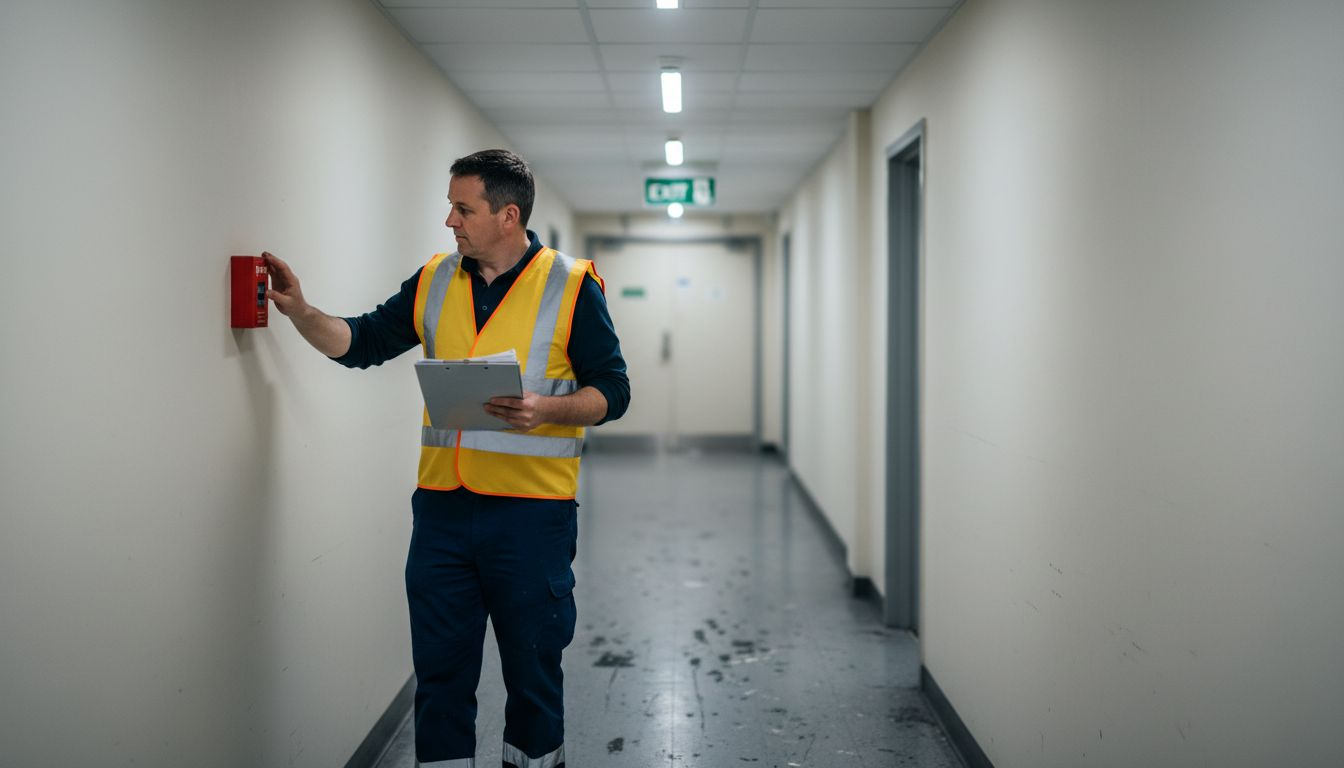
Responsible persons, including Fire Wardens and Fire Marshals, play critical roles in implementing and maintaining fire safety measures. These individuals conduct inspections, manage evacuations during emergencies, and ensure that fire detection systems and emergency exits remain functional. Appointing competent, trained personnel is not just good practice; it’s a legal expectation that demonstrates your commitment to safety.
Non-compliance carries serious consequences. Enforcement authorities can issue improvement notices, impose fines, initiate prosecutions, and even restrict business operations until deficiencies are remedied. Penalties escalate for repeated or serious breaches, and criminal liability may apply where negligence leads to injury or death. Beyond legal penalties, non-compliance damages your reputation, erodes stakeholder confidence, and increases insurance premiums.
Key compliance obligations include:
Conducting regular fire risk assessments and updating them when circumstances change
Establishing clear emergency procedures and evacuation plans
Appointing competent Fire Wardens and Fire Marshals with appropriate training and certification
Maintaining detailed, accessible records of inspections, maintenance, and remedial actions
Ensuring fire detection and alarm systems are tested and serviced according to manufacturer guidelines and Irish standards
“Compliance is not optional. Irish fire safety law demands that every employer and property manager prioritises fire risk management, documentation, and continuous improvement.”
Understanding and fulfilling these responsibilities protects lives, safeguards assets, and ensures your business operates within the law. For more on leadership and accountability in compliance, see compliance leadership responsibility. Additional regulatory details are available from the Health and Safety Authority fire obligations.
Fire detection and reporting standards in Ireland
Irish technical standards provide the blueprint for fire detection system installation, inspection, and reporting. The key standard, I.S. 3218:2024, governs the installation, commissioning, and maintenance of fire detection and alarm systems. This standard specifies inspection frequencies, documentation requirements, and the responsibilities of competent persons.
Fire door inspections in Ireland are recommended to be conducted at least every six months, with individual documentation as per BS 9999 and BS 8214 standards. Each fire door must be inspected individually, with defects recorded and remedial actions tracked. This granular approach ensures that compliance is not assumed but verified door by door.
Fire alarm systems require regular testing and servicing. Routine checks typically include weekly alarm sounders, quarterly full system tests, and annual servicing by qualified technicians. Emergency lighting must be tested monthly, with annual duration tests to confirm batteries perform under emergency conditions. All tests must be documented, with records retained for audit purposes.
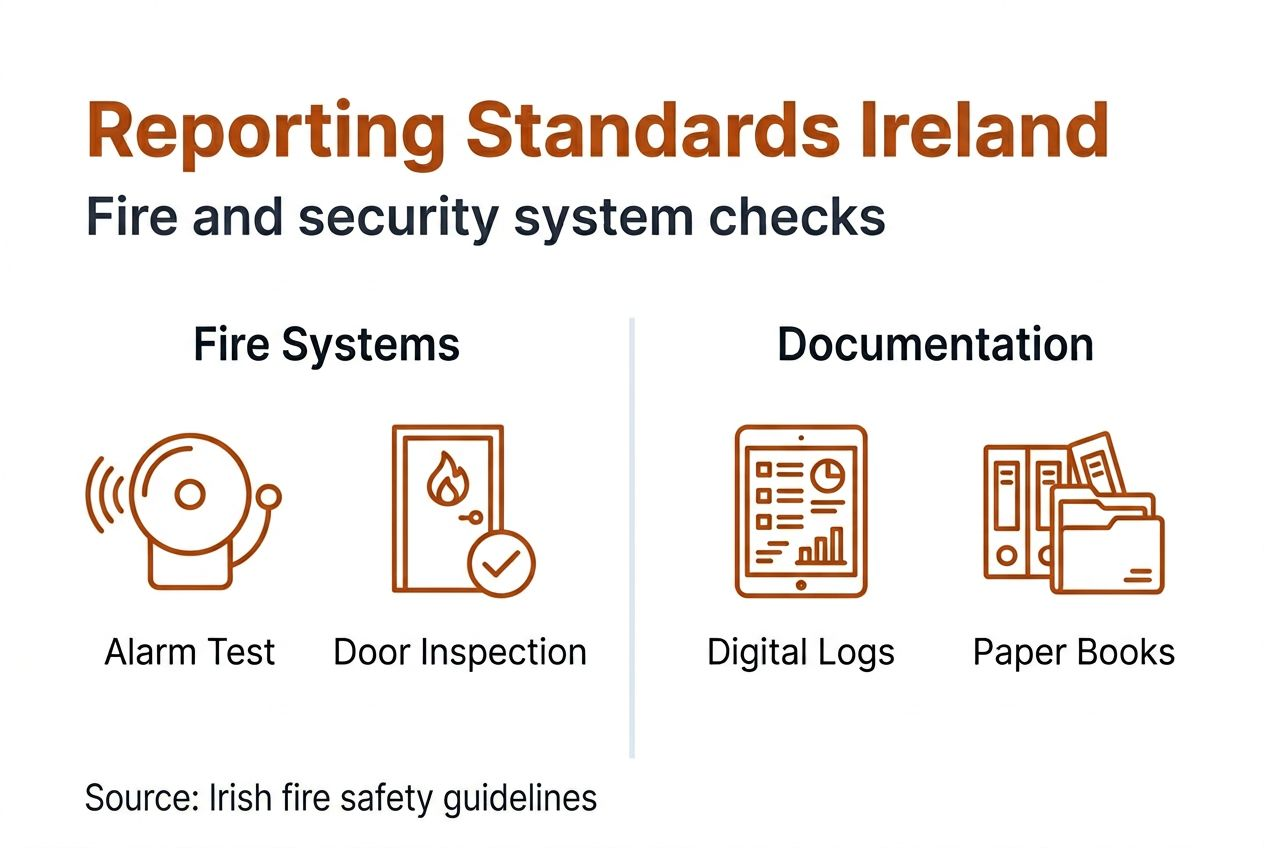
Documentation practices vary significantly between paper-based and digital systems. Paper logbooks are prone to loss, illegibility, and incomplete entries. Digital record keeping, by contrast, enables automated scheduling, instant retrieval during audits, and integration with maintenance management systems. Digital platforms also reduce human error, ensure consistency, and provide real-time visibility of compliance status.
System Component | Recommended Inspection Frequency | Documentation Requirement |
Fire alarm system | Weekly alarm sounders, quarterly full tests, annual servicing | Record test dates, results, defects, and remedial actions |
Fire doors | Every six months | Individual records per door noting condition, defects, and repairs |
Emergency lighting | Monthly function tests, annual duration tests | Log test outcomes, battery performance, and maintenance actions |
Fire extinguishers | Annual inspection by competent person | Certificate of inspection, pressure checks, and servicing records |
Pro Tip: Transition to digital fire and security reporting systems to enhance accuracy, streamline audits, and reduce administrative burden. Digital platforms automatically alert you when inspections are due, ensuring nothing is missed.
For detailed guidance on fire alarm systems, visit fire alarm system basics ireland. To explore professional installation services, see fire alarm system install. Additional technical standards are outlined at fire door inspection ireland standards.
Roles and responsibilities in fire and security reporting
Clear role allocation is essential for effective fire and security reporting. Fire Wardens and Fire Marshals in Ireland have legally defined responsibilities including regular inspections, fire drills, and managing evacuations, with certification recommended for compliance assurance. These individuals act as the operational backbone of fire safety, conducting routine checks, coordinating emergency responses, and liaising with fire services.
Responsibilities are shared among landlords, tenants, and facility managers. In multi-occupancy buildings, landlords typically maintain common areas, fire alarm systems, and emergency lighting, while tenants manage fire safety within their leased spaces. Contracts and service agreements must clearly define who inspects, documents, and maintains each component of the fire safety system. Ambiguity leads to gaps, and gaps lead to compliance failures.
Appointing competent persons is a legal requirement and a practical necessity. Competent persons possess the training, knowledge, and experience to identify fire hazards, conduct inspections, and interpret technical standards. Certification programmes for Fire Wardens and Fire Marshals provide structured training and formal recognition of competence. Certification enhances credibility, demonstrates due diligence, and reassures regulators and stakeholders.
Examples of role-based responsibilities include:
Fire Wardens conduct weekly fire alarm tests, inspect fire doors monthly, and lead evacuation drills
Facility managers schedule annual servicing by qualified fire alarm technicians and maintain centralised compliance records
Landlords ensure fire detection systems in communal areas meet I.S. 3218:2024 standards and coordinate inspections
Tenants report defects immediately, participate in fire drills, and maintain fire safety equipment within their leased premises
Pro Tip: Document role assignments in writing, with clear responsibilities, reporting lines, and escalation procedures. This transparency prevents confusion, ensures accountability, and simplifies audits.
For more on fire door inspection requirements, see fire door inspection ireland FAQs. Additional insights into Fire Warden and Fire Marshal certification are available at fire warden fire marshal certification.
Best practices and technological advances in reporting
Maintaining compliant fire and security reporting documentation requires discipline, structure, and the right tools. Best practices include scheduling inspections at consistent intervals, assigning clear ownership for each task, and using standardised checklists to ensure nothing is overlooked. Remedial actions must be tracked from identification through to completion, with evidence retained for audit purposes.
Digital and AI-assisted fire and security reporting systems represent a significant advance over traditional paper methods. New digital monitoring and AI-assisted inspection technologies are increasingly adopted to improve accuracy, timeliness, and compliance in fire and security system reporting, reducing operational risks by up to 30%. These platforms automate data capture, generate instant reports, send alerts when inspections are due, and provide real-time dashboards showing compliance status across multiple sites.
Technology enhances regulatory compliance by eliminating manual errors, ensuring consistency, and providing auditors with comprehensive, searchable records. Digital systems integrate with maintenance management software, enabling seamless coordination between inspection schedules and remedial work orders. Case examples show organisations achieving significant time savings, reduced administrative costs, and improved audit outcomes after adopting digital reporting tools.
Steps to evaluate and implement reporting software include:
Assessing your current reporting processes to identify pain points and inefficiencies
Defining requirements based on the number of sites, inspection frequencies, and integration needs
Evaluating software vendors on features, compliance support, user-friendliness, and customer service
Piloting the solution at one site before rolling out across your portfolio
Training users thoroughly to maximise adoption and accuracy
Reporting Method | Advantages | Disadvantages |
Paper-based | Low initial cost, familiar to staff | Prone to loss, illegibility, incomplete entries, difficult to audit |
Digital platforms | Automated scheduling, instant retrieval, integration with maintenance systems, reduced errors | Requires initial investment, staff training, and technology infrastructure |
AI-assisted systems | Predictive analytics, anomaly detection, real-time compliance dashboards, enhanced risk management | Higher cost, complexity, dependency on data quality |
Pro Tip: Invest in digital reporting tools that integrate with your existing fire alarm and monitoring systems. Integration eliminates double entry, improves data accuracy, and provides a single source of truth for compliance.
For insights into securing your business holistically, explore business security essentials ireland 5 key steps 2026. Additional context on compliance technology trends is available at fire safety compliance legislation update.
Common misconceptions and compliance pitfalls
Misunderstandings about fire and security reporting responsibilities undermine compliance efforts. Many businesses mistakenly believe fire safety reporting is one-time, though it legally requires continuous inspections and documentation; responsibility is shared among multiple parties, not just property owners. This misconception leads to complacency, where initial installations are never followed up with scheduled inspections or maintenance.
Another common error is assuming that fire safety responsibility rests solely with property owners. In reality, landlords, tenants, facility managers, and appointed competent persons all share accountability. Contracts must clearly define who inspects, documents, and maintains each component. Ambiguity creates gaps, and gaps invite non-compliance.
Incomplete or generalised fire door inspections represent a significant risk. Inspecting fire doors as a group, rather than individually, fails to identify door-specific defects such as damaged seals, faulty closers, or obstructed pathways. Each fire door must be inspected individually, with findings documented separately. This granular approach ensures that every door performs its life-saving function in an emergency.
Irregular inspections and poor documentation lead to legal penalties. Enforcement authorities expect to see consistent, detailed records that demonstrate ongoing compliance. Missing entries, incomplete data, or outdated records signal neglect and invite scrutiny. Penalties can include fines, prosecutions, and operational restrictions that disrupt your business.
Common pitfalls to avoid include:
Treating fire safety reporting as a one-time task rather than a continuous legal duty
Failing to define and document responsibilities among landlords, tenants, and managers
Conducting generalised inspections instead of individual, detailed assessments
Relying on paper logbooks that are prone to loss or incomplete entries
Neglecting training and certification for Fire Wardens and Fire Marshals
Ignoring remedial actions or delaying repairs to fire safety equipment
“Compliance is not a destination; it’s a journey of continuous vigilance, accurate documentation, and proactive risk management.”
For more on accountability and leadership in compliance, see compliance leadership responsibility. To understand how proper systems support compliance, explore commercial security done properly. Additional clarification on fire door inspection requirements is available at fire door inspection ireland FAQs.
Conclusion and practical steps for compliance
Fire and security reporting in Ireland demands continuous attention, structured processes, and clear accountability. Irish law imposes statutory duties on employers, property managers, and responsible persons to conduct fire risk assessments, schedule regular inspections, maintain detailed documentation, and appoint competent individuals. Technical standards like I.S. 3218:2024 govern fire detection system installation and reporting, while roles including Fire Wardens and Fire Marshals ensure operational compliance.
Digital and AI-assisted reporting tools enhance accuracy, streamline audits, and reduce operational risks. These platforms automate scheduling, eliminate manual errors, and provide real-time compliance dashboards. Adopting digital solutions is no longer optional; it’s a practical necessity for organisations managing multiple sites or complex fire safety systems.
To implement effective fire and security reporting compliance, follow this checklist:
Conduct comprehensive fire risk assessments and update them regularly to reflect changes in occupancy or operations
Schedule inspections according to recommended frequencies: weekly alarm tests, six-monthly fire door inspections, annual servicing
Appoint competent Fire Wardens and Fire Marshals with appropriate training and certification
Maintain detailed, audit-ready records of all inspections, defects, and remedial actions
Transition to digital reporting systems to improve accuracy, consistency, and audit readiness
Regularly review and update compliance practices to align with evolving regulations and standards
Prioritise training and certification to enhance safety leadership and demonstrate due diligence
Partnering with experienced professionals ensures your fire alarm systems, access control, and monitoring solutions meet Irish standards. For expert installations and ongoing support, explore fire alarm system install services tailored to your compliance needs.
Explore fire and security solutions with Signal Fire & Security
Ensuring compliance with fire and security reporting obligations requires reliable systems and expert support. Signal Fire & Security provides comprehensive fire alarm system installations designed to meet Irish regulatory standards, including I.S. 3218:2024. Our access control installation services integrate seamlessly with fire safety systems, enhancing overall property security and streamlining compliance management.
Advanced monitoring solutions from Signal Fire & Security help you maintain continuous compliance by providing real-time alerts, automated inspection scheduling, and centralised documentation. Partner with Signal Fire & Security to ensure your property management meets 2026’s fire safety requirements with confidence, accuracy, and efficiency.
Frequently asked questions
What is the required frequency for fire door inspections in Ireland?
Fire door inspections in Ireland are recommended at least every six months, with individual records for each door according to BS 9999 and BS 8214 standards. Each door must be inspected separately to identify defects such as damaged seals, faulty closers, or obstructions. This granular approach ensures every fire door functions correctly in an emergency.
Who is responsible for fire and security reporting in commercial properties?
Responsibility for fire and security reporting is shared legally among landlords, tenants, facility managers, and appointed competent persons with defined roles. Contracts and service agreements should clearly specify who inspects, documents, and maintains each component. Ambiguity in role allocation creates compliance gaps and increases legal risk.
How can technology improve fire and security reporting compliance?
Digital monitoring and AI-assisted systems enhance accuracy, speed, and compliance tracking in fire and security reporting, reducing risks by up to 30%. These platforms automate data capture, send alerts when inspections are due, and provide real-time dashboards showing compliance status. Technology eliminates manual errors, ensures consistency, and simplifies audits.
What are the penalties for non-compliance with Irish fire safety regulations?
Non-compliance with Irish fire safety regulations can result in improvement notices, fines, prosecutions, and operational restrictions until deficiencies are remedied. Serious or repeated breaches may lead to criminal liability, especially where negligence causes injury or death. Beyond legal penalties, non-compliance damages reputation, erodes stakeholder confidence, and increases insurance premiums.
Recommended


Comments